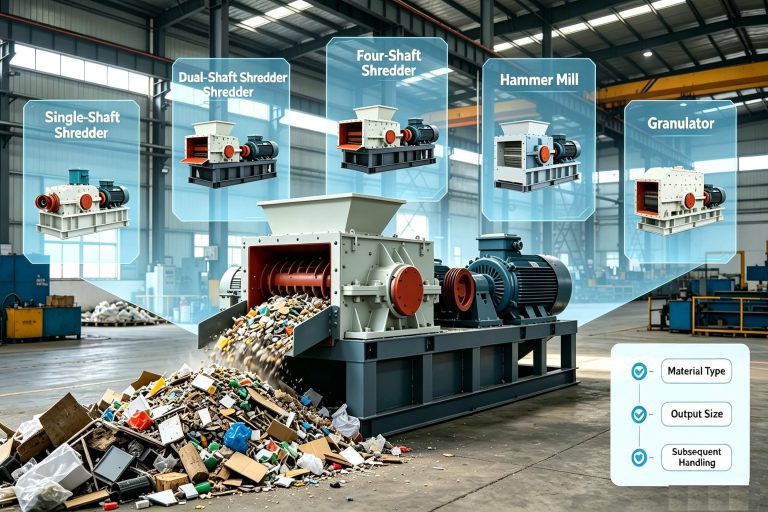
How to Choose a Tire Recycling Machine?
Most buyers come to us with the same first question: "What’s the price?" But that’s actually the wrong place to start — and starting there is how people end up with expensive mistakes.
Choosing a tire recycling machine is really a business configuration decision. Your end product and your daily throughput determine your process route, and your process route determines your equipment. Get that sequence right, and the machine choice becomes much clearer.
We’ve worked with buyers across more than 20 countries — tire recyclers, environmental project firms, rubber product manufacturers, and pyrolysis operators. The ones who struggle most are the ones who skip the first steps and jump straight to comparing machine models. This post walks you through the decision in the order that actually matters.
Is a Tire Recycling Business Profitable?
The honest answer is: it depends on what you’re selling and to whom. And that’s not a dodge — it’s the most useful thing I can tell you.
Tire recycling can be profitable, but the margin and the model look very different depending on your output.1 Rubber powder for modified asphalt commands different pricing than tire-derived fuel or pyrolysis oil.2 Your profitability starts with picking the right output for your market — not picking a machine.
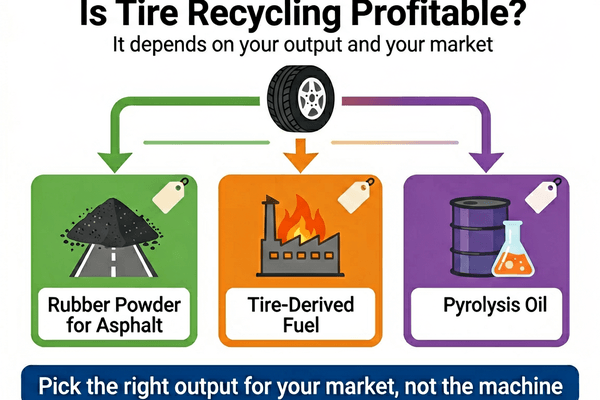
Let me break down how I usually walk buyers through this.
What Are You Actually Selling?
There are two main technology paths in tire recycling: ambient-temperature mechanical processing and pyrolysis. These are not the same thing, and they are not interchangeable — even though some vendors market both under the same "tire recycling" label.
Ambient-temperature mechanical processing shreds and grinds waste tires into rubber powder, steel wire, and fiber. The rubber powder is the main product. It gets sold into rubber flooring, sports tracks, highway-modified asphalt, shoe soles, and construction materials. The process runs without burning, so there’s no combustion byproduct and no secondary pollution risk.
Pyrolysis uses heat to break down rubber into fuel oil, carbon black, and steel wire. The oil is the main product — sold as tire-derived fuel (TDF) or further refined. This path suits buyers in fuel markets or those targeting carbon black applications.
| Output Type | Technology Path | Typical Buyers |
|---|---|---|
| Rubber powder | Ambient mechanical | Flooring, track, asphalt, shoe sole makers |
| Tire-derived fuel / oil | Pyrolysis | Fuel resellers, energy plants |
| Carbon black | Pyrolysis | Industrial buyers, pigment users |
| Steel wire | Both | Scrap metal recyclers |
Neither path is universally better. The right one depends entirely on what you can sell in your market.
Why Does Output Quality Matter So Much?
Here’s something that almost never appears in product brochures: the acceptable quality of your rubber powder depends on what it’s going to be used for.
Rubber powder for highway-modified asphalt typically requires a specific fineness level and strict steel-wire separation standards.3 If steel wire contamination is too high, road contractors won’t buy it. Rubber powder for flooring or shoe soles may have different fineness tolerances.
A machine that meets the quality standard for one application may not meet it for another.4 So before you compare two machines on price or output volume, you need to know what quality standard your buyer expects. That spec drives the machine spec — not the other way around.
The Real Profitability Question
In our experience across the projects we’ve supported, buyers who build a profitable business usually do three things first:
- They confirm a downstream buyer for their output before they buy equipment.
- They match their machine capacity to their actual feedstock supply, not their hoped-for supply.
- They choose a process route that fits the product, not the other way around.
The buyers who struggle usually do the opposite — they find a machine they can afford, then try to figure out what to sell and to whom.
How Much to Start a Tire Recycling Business?
This is the second most common question we get, right after "what’s the price of the machine." And again — the honest answer is that the machine cost is only one part of the number.
The total cost to start a tire recycling business depends on your capacity target, your process route, your site conditions, and what’s included in your equipment package. In our experience, projects in this space range widely — and the gap between a small setup and a full production line can be very large.
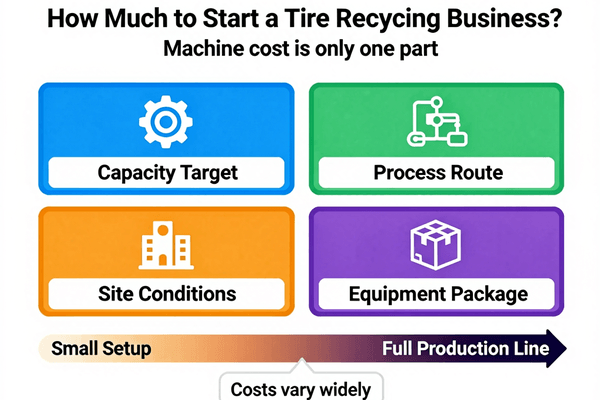
Let me walk through the cost factors that actually matter.
Capacity Is the Biggest Variable
The first sizing question is: how many tons of waste tires can you actually collect per day?5
This sounds obvious, but many buyers skip it. They look at a machine rated for 5 tons/day because it sounds like a solid output — but if their local market only generates 1 ton/day of feedstock, that machine is sitting idle most of the time. That’s not a profitability issue. That’s a capital trap.
Before we discuss any machine model or price, we always ask buyers to walk us through their input supply. Where are the tires coming from? How many tons per day, realistically — not optimistically?
| Capacity Range | Suitable For | Notes |
|---|---|---|
| Under 1 ton/day | Small operators, pilots | Entry-level, limited end-product options |
| 1–5 tons/day | Mid-size recyclers | Most common project size we support |
| 5–10+ tons/day | Industrial scale | Requires more land, power, logistics |
Once you know your real daily input, you can size your equipment correctly. Oversizing wastes capital. Undersizing means you can’t serve demand as it grows — and retrofitting is always more expensive than sizing right the first time.6
What Does the Equipment Package Actually Include?
Machine price and total project cost are not the same number.7
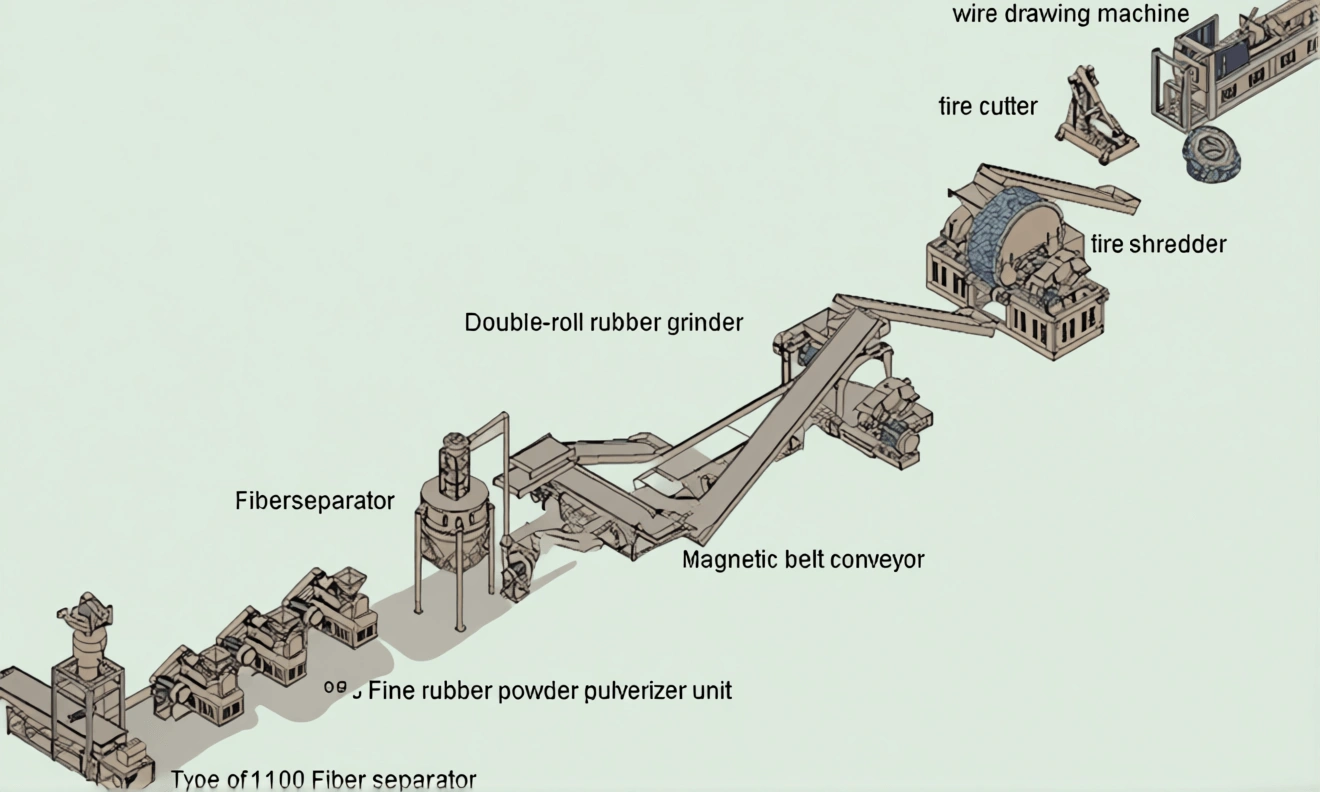
A complete ambient-temperature tire recycling line typically includes shredding equipment, granulating equipment, steel wire separation, fiber separation, and rubber powder screening systems.8 Depending on the fineness you need, you may also need a fine grinding stage.
Other cost factors to account for:
| Cost Item | What It Affects |
|---|---|
| Site preparation and civil work | Varies by location and ground conditions |
| Electrical and utility installation | Depends on local infrastructure |
| Shipping and import duties | Significant for cross-border projects |
| Installation and commissioning | Some suppliers include this, some don’t |
| Operator training | Affects how quickly your team can run the line |
| Spare parts and maintenance | Ongoing cost, often underestimated |
When we work with buyers on project planning, we try to give them a full-system picture — not just the machine price. A low machine price that hides high installation costs or frequent maintenance needs is not actually a low cost.
What’s a Realistic Starting Budget?
I can’t give you a single number here, and I’d be cautious of any supplier who does without knowing your specs first. What I can tell you is that the most useful conversation we have with new buyers isn’t about budget — it’s about:
- What output do you want to produce?
- How many tons per day is realistic for your feedstock supply?
- What quality standard does your downstream buyer require?
Those three questions produce a configuration. The configuration produces a real cost estimate. That’s a much more useful number than any ballpark figure I could put in this article.
Conclusion
Choosing a tire recycling machine starts with your end product and your real daily volume — get those right first, and the equipment decision becomes straightforward.9
If you’re currently working through this decision, tell us what output you’re targeting and how much feedstock you have access to. We’ll come back to you with a configuration that actually fits your situation — not a generic quote.
-
"Small Business Tire Recycling: Startup Guide – Gradeall International", https://gradeall.com/small-business-tire-recycling-complete-startup-guide/. A study on tire recycling profitability highlights that rubber powder and pyrolysis oil markets have distinct pricing structures and demand patterns, influencing business margins. Evidence role: statistic; source type: research. Supports: Profitability in tire recycling varies based on the type of output and market demand.. Scope note: Profitability data may vary by region and market conditions. ↩
-
"Tire-Derived Fuel | Scrap Tires | US EPA", https://archive.epa.gov/epawaste/conserve/materials/tires/web/html/tdf.html. Market reports from industry institutions show that rubber powder for asphalt and pyrolysis oil have different pricing structures due to their application-specific demand. Evidence role: statistic; source type: institution. Supports: Rubber powder and pyrolysis oil have distinct market prices based on their applications.. Scope note: Pricing may fluctuate based on regional and global market trends. ↩
-
"Crumb Rubber Modifier", https://www.intrans.iastate.edu/wp-content/uploads/sites/10/2019/01/PB93217297.pdf. Industry guidelines for asphalt modification specify fineness and contamination limits for rubber powder used in road construction. Evidence role: expert_consensus; source type: institution. Supports: Rubber powder used in highway-modified asphalt must meet specific fineness and steel-wire separation standards.. Scope note: Standards may vary by country or region. ↩
-
"[PDF] TIRE SHRED INITIATIVE: SUMMARY REPORT – nysdot", https://www.dot.ny.gov/divisions/engineering/technical-services/technical-services-repository/Shreds_Summary_RPT.pdf. Educational materials on tire recycling emphasize that machine specifications must align with the quality requirements of the intended application. Evidence role: general_support; source type: education. Supports: Different applications of rubber powder require machines with specific quality standards.. Scope note: Specific examples of machine differences are not provided. ↩
-
"Tire Management | Environmental Protection Division – Georgia.gov", https://epd.georgia.gov/about-us/land-protection-branch/recovered-materials-and-abatement/tire-management. Research on tire recycling projects highlights the importance of matching equipment size to daily feedstock supply to optimize operations. Evidence role: mechanism; source type: research. Supports: Daily waste tire collection capacity determines the appropriate size of tire recycling equipment.. Scope note: Specific case studies may be needed for detailed insights. ↩
-
"[PDF] Equipment Sizing and Capital Cost Estimation – Penn Engineering", https://www.seas.upenn.edu/~dlewin/CACHE_Workshop/LECTURE_06_Equipment_Sizing_and_Capital_Cost_Estimation.pdf. Case studies in tire recycling demonstrate that oversizing equipment leads to underutilization, while undersizing limits growth and incurs retrofitting expenses. Evidence role: case_reference; source type: research. Supports: Incorrect equipment sizing can result in wasted capital or higher retrofitting costs.. Scope note: Specific financial figures may vary by project scale. ↩
-
"[PDF] Itemized Cost Worksheet – Scrap Tire Cleanup – Delaware.gov", https://documents.dnrec.delaware.gov/Admin/Public-Notices/WHS20260106/STS-Cleanup.pdf. Institutional reports on tire recycling projects outline the various cost components beyond machine price, including installation and site preparation. Evidence role: general_support; source type: institution. Supports: Total project costs in tire recycling include machine price, site preparation, utilities, and other factors.. Scope note: Cost breakdowns may differ based on regional conditions. ↩
-
"Tire Recycling Process: Your Complete Guide to Equipment", https://gradeall.com/the-tire-recycling-process-how-does-it-work/. Educational resources on tire recycling describe the standard components of ambient-temperature recycling lines, including shredding and separation systems. Evidence role: definition; source type: education. Supports: Ambient-temperature tire recycling lines typically include shredding, granulating, and separation systems.. Scope note: Specific configurations may vary by manufacturer. ↩
-
"[PDF] The Effect of Trading Volume on Stock Price", https://cupola.gettysburg.edu/cgi/viewcontent.cgi?article=1032&context=gchq. Educational materials on tire recycling emphasize that understanding the desired output and feedstock volume simplifies equipment selection. Evidence role: mechanism; source type: education. Supports: End product and daily feedstock volume are key factors in selecting tire recycling equipment.. Scope note: Specific examples of equipment configurations are not provided. ↩