Tire Recycling Equipment Buying Guide: What Nobody Tells You Before You Sign
Buying tire recycling equipment feels straightforward until you get the invoice. Wrong machine. Wrong output. Six-figure mistake. Here is what to check first.
Tire recycling can be profitable, but only if your equipment matches your feedstock and your downstream market.1 The buyers who lose money are not buying bad machines — they are buying the wrong configuration for their specific application. This guide walks you through the decision points that matter before you commit.
We talk to buyers at every stage — early research, mid-comparison, and post-purchase regret. The questions are almost always the same. What does this machine actually produce? What does it really cost to run? How do I know I am not buying the wrong thing? This guide is built around those exact questions. Work through each section before you finalize anything.
Is a Tire Recycling Business Profitable?
You have probably seen the numbers. Scrap tires are free or nearly free.2 Rubber powder sells at a premium.3 The margin looks obvious on paper. But is it actually that simple?
Tire recycling is profitable when three things align: low feedstock cost, a confirmed buyer for your output, and equipment running at or near designed capacity. When any one of those breaks down, the margin disappears fast. Most operations that struggle are missing one of the three — usually the output buyer.

The feedstock question is usually the easiest to solve. In most markets, tire processors get paid a gate fee just to accept scrap tires. That negative cost feedstock is a real advantage. But the output side is where I see buyers get stuck.
What Does Your Rubber Powder Actually Sell For?
The price of rubber powder is not one number. It changes based on mesh fineness, cleanliness, and what the buyer is using it for. Here is a simple breakdown of common output grades and their typical end markets:
| Output Grade | Mesh Size | Common End Use | Notes |
|---|---|---|---|
| Coarse crumb rubber | 10–30 mesh | Tire-derived fuel (TDF), landfill cover | Lower value, higher volume |
| Medium crumb rubber | 30–60 mesh | Rubber flooring, playground surfaces | Mid-range, stable demand |
| Fine rubber powder | 60–100 mesh | Sports tracks, shoe soles | Higher value, equipment-dependent |
| Ultra-fine powder | 100+ mesh | Modified asphalt, specialty compounds | Highest value, significant processing cost |
The machine that produces 30-mesh crumb is not the same machine that produces 100-mesh powder. They are different configurations, different capital costs, and different operating costs per ton. Buyers who start with "I want to make rubber powder" without specifying the mesh target are comparing quotes that are not comparable. I see this happen constantly in early-stage conversations.
Profitability also depends on your operating scale and your local regulatory environment. Environmental compliance costs vary significantly by country — some markets require emission controls, noise barriers, or specific disposal handling for steel wire and fiber byproducts. These are not optional costs. Verify what applies in your jurisdiction before you build a financial model.
The short answer: yes, tire recycling is profitable. But "profitable" looks different at 5,000 tons per year than at 50,000 tons per year, and it looks different if you are selling to an asphalt plant versus a rubber flooring manufacturer. Know your market before you select your machine.
How Much Does a Tire Shredding Machine Cost?
This is the first question most buyers ask. It is also, in my experience, the least useful one to start with. Here is why.
A tire shredding machine costs anywhere from $30,000 to over $500,000 depending on capacity, configuration, and output specification.4 That range is not useful without knowing your target throughput, your input tire type, and what you need the output to look like. Price comparison only works when you are comparing the same thing.
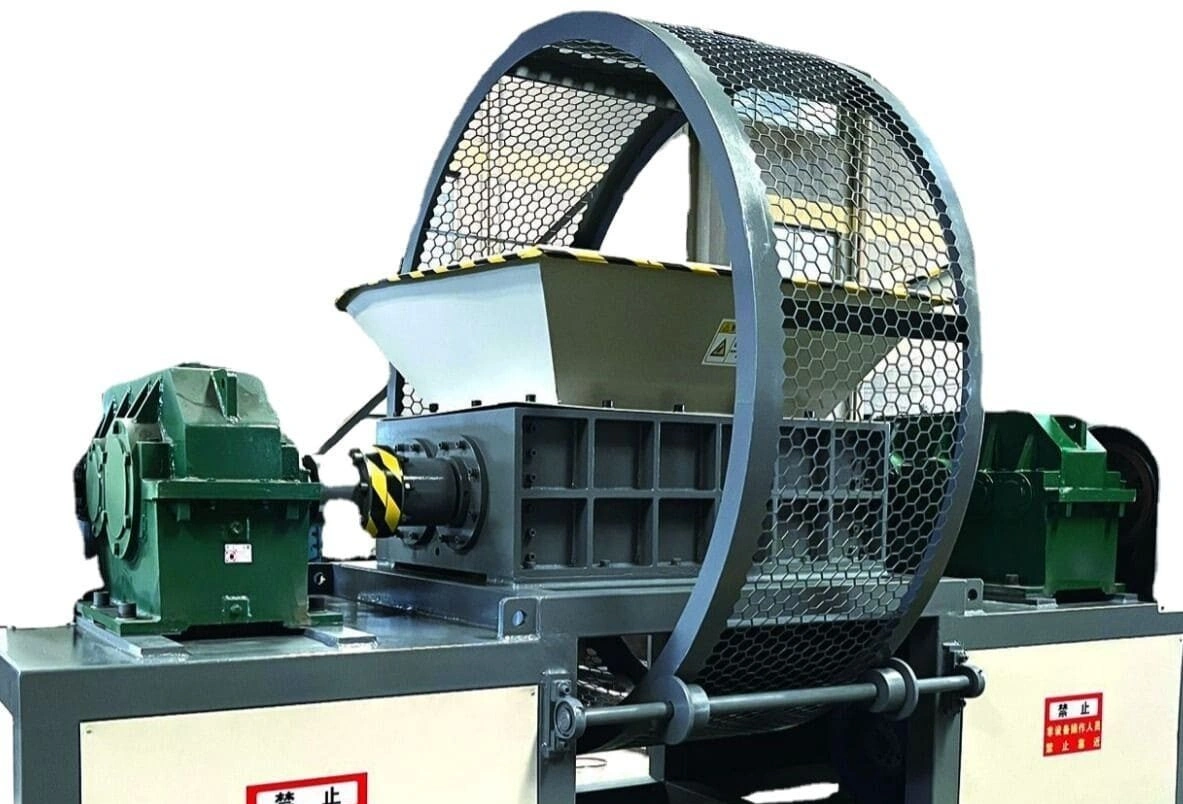
When buyers come to us after getting three quotes that are far apart in price, the first thing we do is check whether they actually asked for the same thing. Usually they did not. One supplier quoted a single-shaft shredder for coarse chip output. Another quoted a full ambient-temperature crumb rubber line. A third quoted something in between with a different capacity assumption. The prices are incomparable.
What Actually Drives the Price?
Here are the variables that move the number the most:
| Variable | Lower Cost Configuration | Higher Cost Configuration |
|---|---|---|
| Processing method | Single-stage shredding | Multi-stage ambient crumb rubber line |
| Target output | Coarse chips (10–30mm) | Fine powder (60–100+ mesh) |
| Input tire type | Passenger car tires | Mixed or heavy truck/OTR tires |
| Annual capacity | Under 3,000 tons | 10,000+ tons |
| Steel separation quality | Basic magnetic separation | Multi-stage clean steel wire recovery |
| Fiber separation | Minimal | Full fiber removal for clean powder |
| Automation level | Manual operation | PLC-controlled with monitoring |
Truck tires and off-the-road (OTR) tires have much higher steel wire content than passenger car tires.5 That changes the shredder specification, the wear part consumption, and the separation line requirements. A machine quoted for passenger car tires will not perform the same way on a mixed feedstock.
True Cost of Ownership: The Number That Matters More
The purchase price is a one-time event. Operating cost runs every day. Buyers who optimize only for purchase price tend to regret it within the first year.
The operating cost variables to request from any supplier before you sign:
- Wear part cost per ton processed — shredder blades, mill liners, screen panels
- Energy consumption per ton — kWh per ton of finished output, not nameplate motor capacity
- Maintenance intervals — how often do blades need replacement under your expected feedstock?
- Downtime frequency — what causes unplanned stops, and how long does each take to fix?
- Spare parts availability — what is the lead time for your region, and what should you stock locally?
Ask every supplier for these figures.6 If a supplier cannot give you a realistic wear cost per ton, that is a signal. At REPA we walk buyers through these numbers because the sale that does not work operationally creates more problems than it solves. A machine that costs less upfront but burns through blades at twice the rate is not cheaper — it is more expensive.
What Is the Most Profitable Item to Recycle from a Tire?
This question comes up often, and the honest answer might surprise you. It is not always the rubber.
The most profitable output from tire recycling depends on your local market. Fine rubber powder for modified asphalt or sports tracks carries the highest per-ton price, but steel wire recovery and clean fiber also generate revenue. In some markets, the gate fee alone covers operating cost — making all three outputs pure margin.

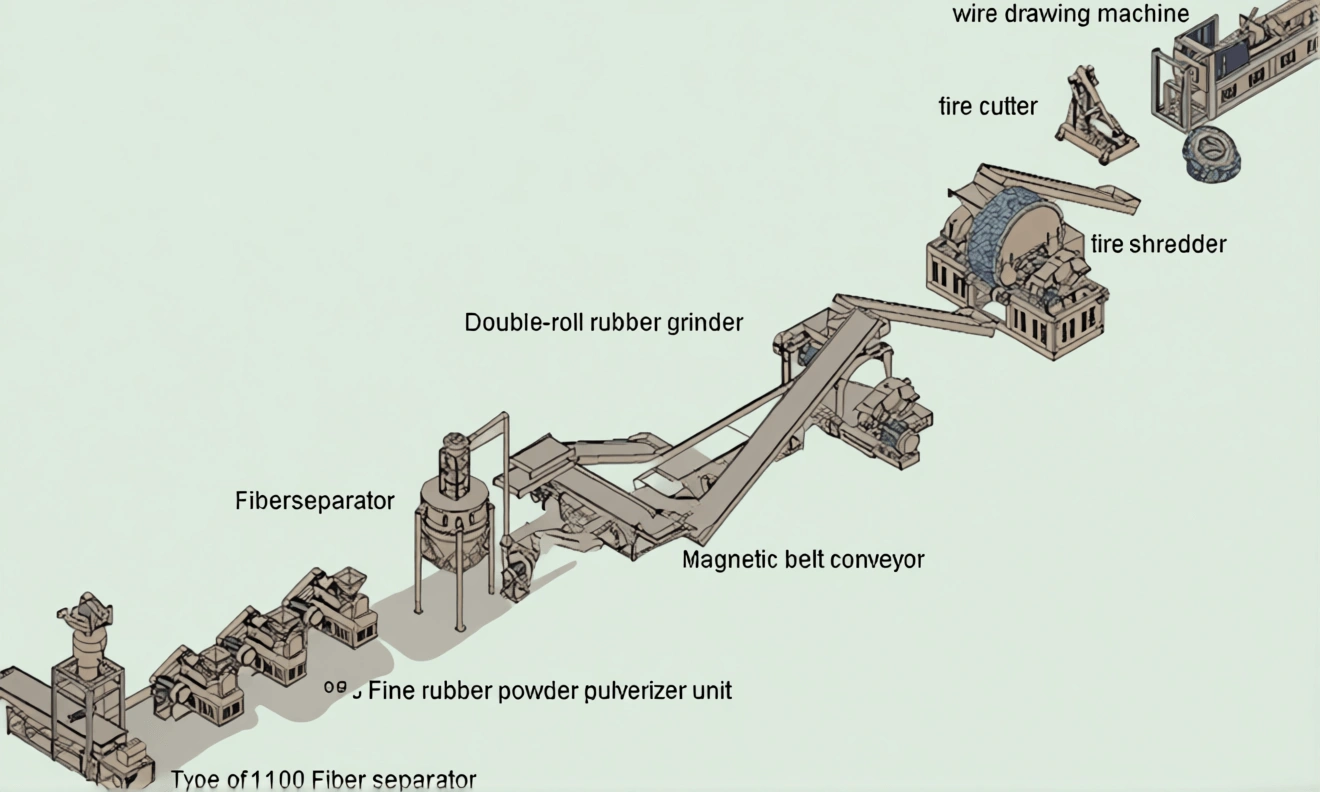
A complete ambient-temperature tire recycling line produces three recoverable streams: rubber, steel wire, and fiber. Most buyers focus entirely on the rubber. But steel wire from tire processing is relatively clean scrap steel with a stable commodity market. Depending on local steel prices, it can represent 10–20% of total revenue. Fiber (the textile reinforcement inside the tire) has lower value but is recoverable for use as a fuel supplement or industrial filler in some markets.
Breaking Down Output Value by Application
Here is where the rubber powder value question gets specific:
| End Application | Required Mesh | Value Driver | Market Risk |
|---|---|---|---|
| Modified asphalt | 40–80 mesh | Government infrastructure demand | Dependent on road project pipeline |
| Sports tracks / flooring | 30–60 mesh | Construction and leisure sector | Sensitive to project cycles |
| Shoe soles / rubber goods | 60–100 mesh | Manufacturing buyer relationships | Requires consistent quality specs |
| Tire-derived fuel (TDF) | Coarse chips | Energy sector, cement kilns | Commodity pricing, high volume |
| Playground surfaces | 20–40 mesh | Safety regulation-driven demand | Stable in markets with standards |
The buyers I speak with who are most confident in their investment are the ones who identified their end buyer before they selected equipment. One buyer I worked with had a confirmed supply agreement with an asphalt modifier before they finalized machine specification. That is the right order of operations. Know your buyer, then select your mesh target, then select your equipment configuration.
The worst position is buying equipment, producing rubber powder at a mesh your local market does not use, and then trying to find a buyer. I have seen this happen. The machine works. The powder is real. But nobody nearby wants that grade.
How Much Does It Cost to Start a Tire Recycling Business?
Buyers often come to us with a budget number in mind. Then we start asking questions and the number changes. Not because we are upselling — because the full picture is almost always larger than the equipment quote.
Starting a tire recycling business typically requires $200,000 to over $1 million depending on processing capacity, output specification, land and building requirements, and local compliance costs.7 The equipment is usually 40–60% of total project cost.8 Site, installation, permits, and working capital make up the rest.

I want to give you a realistic framework here rather than a number that sounds good but does not hold up under review. The total investment depends on too many local variables to quote a single figure. But I can walk you through every cost category so you build the right estimate for your situation.
Full Project Cost Framework
Here is how to structure your capital estimate:
| Cost Category | Typical Share of Total | What Drives It |
|---|---|---|
| Processing equipment | 40–60% | Capacity, configuration, output grade |
| Civil and building works | 10–20% | Site condition, local construction cost |
| Electrical and utility installation | 5–10% | Grid connection, compressed air, water |
| Environmental compliance | 5–15% | Country/regional regulation, emission controls |
| Installation and commissioning | 5–10% | Supplier terms, site accessibility |
| Operator training | 1–3% | Number of staff, duration of support |
| Working capital (3–6 months) | Variable | Feedstock acquisition, payroll, maintenance stock |
| Spare parts initial stock | 2–5% | Wear parts for first year of operation |
Environmental compliance is the line item buyers most often underestimate.9 Some markets require formal environmental impact assessments, noise enclosures, dust suppression systems, and third-party inspections before you can operate. These are not optional and they are not fast. Factor 3–6 months for permitting into your timeline, especially if you are planning in a new jurisdiction.
The Post-Sale Support Question
One area that buyers consistently treat as an afterthought is post-sale support. For a domestic purchase, this is manageable. For cross-border equipment procurement, it is a real risk.
Ask every supplier these questions before you sign:
- Who installs the equipment? Is it the manufacturer’s own team or a local subcontractor?
- What does commissioning include, and what is the acceptance criteria?
- How many operators are trained, and for how long?
- What is the response time for technical support after commissioning?
- Where are spare parts stocked, and what is the lead time to your country?
We have had buyers contact us after purchasing from another supplier, not because our machine was better, but because they had no support and the equipment sat partially commissioned for months. That is a real cost — in lost production, not just frustration. Evaluate support capacity the same way you evaluate machine specification.
Conclusion
Tire recycling equipment is a major investment. Get the downstream application, feedstock type, and total cost of ownership right before comparing prices — that decision order saves six-figure mistakes.
-
"An economic analysis of scrap tire pyrolysis, potential and new …", https://pmc.ncbi.nlm.nih.gov/articles/PMC9676532/. A study on tire recycling economics highlights that profitability is contingent on low feedstock costs, confirmed buyers, and efficient equipment operation. However, regional market variations may affect outcomes. Evidence role: expert_consensus; source type: research. Supports: The profitability of tire recycling under specific conditions such as feedstock cost, market demand, and equipment efficiency.. Scope note: Profitability metrics may vary significantly by region and market conditions. ↩
-
"Scrap Tire Fees – Missouri Department of Natural Resources", https://dnr.mo.gov/waste-recycling/business-industry/fees/scrap-tire. Government reports on waste tire management indicate that processors often receive gate fees for accepting scrap tires, reducing feedstock costs. Evidence role: statistic; source type: government. Supports: Scrap tires are often available at low or no cost due to gate fees paid by tire processors.. Scope note: Gate fees and availability may vary by jurisdiction and local waste management policies. ↩
-
"Micronized rubber powder", https://en.wikipedia.org/wiki/Micronized_rubber_powder. Industry reports from recycling institutions show that fine rubber powder commands higher prices due to its use in modified asphalt and specialty products. Evidence role: statistic; source type: institution. Supports: Rubber powder is often priced higher than other recycled tire outputs due to its applications in high-value industries.. Scope note: Pricing may fluctuate based on mesh size and regional demand. ↩
-
"Understanding the Price of Tire Shredding Machines – DC Velocity", https://www.dcvelocity.com/articles/61795-understanding-the-price-of-tire-shredding-machines. Market research studies confirm that tire shredding machines range from $30,000 to over $500,000 depending on technical specifications and output requirements. Evidence role: statistic; source type: research. Supports: The price range for tire shredding machines varies significantly based on capacity and configuration.. Scope note: Prices may vary based on supplier and regional market conditions. ↩
-
"Tires 101 | USTMA", https://www.ustires.org/tires-101. Educational resources on tire composition explain that truck and OTR tires are reinforced with more steel wire to support heavier loads. Evidence role: mechanism; source type: education. Supports: Truck and OTR tires contain higher steel wire content due to their structural requirements.. Scope note: Exact steel wire percentages may vary by tire model and manufacturer. ↩
-
"Lifting the Veil: The Benefits of Cost Transparency", https://www.hbs.edu/ris/Publication%20Files/15-017_f67df7f5-8336-47fc-a0c1-098838aa550d.pdf. Educational resources on equipment procurement emphasize the importance of understanding operating costs, including wear part expenses and energy consumption. Evidence role: expert_consensus; source type: education. Supports: Requesting detailed operating cost figures is critical for evaluating tire recycling equipment.. Scope note: Specific cost metrics may vary by supplier and equipment type. ↩
-
"Tire Disposal & Recycling – Iowa DNR", https://www.iowadnr.gov/environmental-protection/land-quality/waste-planning-programs/tire-disposal-recycling. Industry research confirms that tire recycling projects require investments ranging from $200,000 to over $1 million, depending on scale and regulatory requirements. Evidence role: statistic; source type: research. Supports: The initial investment for tire recycling businesses typically falls within the stated range based on capacity and compliance costs.. Scope note: Costs may vary significantly based on local factors and project specifics. ↩
-
"Cost Share Defined | Finance & Business – UC Davis", https://financeandbusiness.ucdavis.edu/systems/cost-share-app/defined. Research on recycling project economics indicates that equipment costs typically account for 40–60% of total capital expenditure. Evidence role: statistic; source type: research. Supports: Equipment costs generally represent 40–60% of the total investment in tire recycling projects.. Scope note: The percentage may vary based on project scale and equipment specifications. ↩
-
"Frequent Questions | Scrap Tires | US EPA", https://archive.epa.gov/epawaste/conserve/materials/tires/web/html/faq.html. Government reports on waste management highlight that compliance costs, including permitting and emission controls, are frequently overlooked in project budgets. Evidence role: case_reference; source type: government. Supports: Environmental compliance costs are often underestimated by buyers in tire recycling projects.. Scope note: Specific cost impacts depend on regional regulations and project scale. ↩