
Tire Recycling Process Explained: Which Technology Actually Fits Your Goals?
When you search for "tire recycling process," you expect one answer. You get confused because there isn’t one. The process you need depends on what you plan to do with the rubber after it’s separated from steel and fiber. I’ll walk you through how to think about this decision, because I spend my days helping customers figure out which process actually matches their real requirements.
The tire recycling process isn’t a fixed sequence—it’s a choice between mechanical grinding, pyrolysis, and cryogenic methods.1 Your choice depends on three factors: what output you need, what contamination level your buyer accepts, and how much capital you have to invest. This article explains how these constraints work together so you can decide which direction makes sense for your situation.
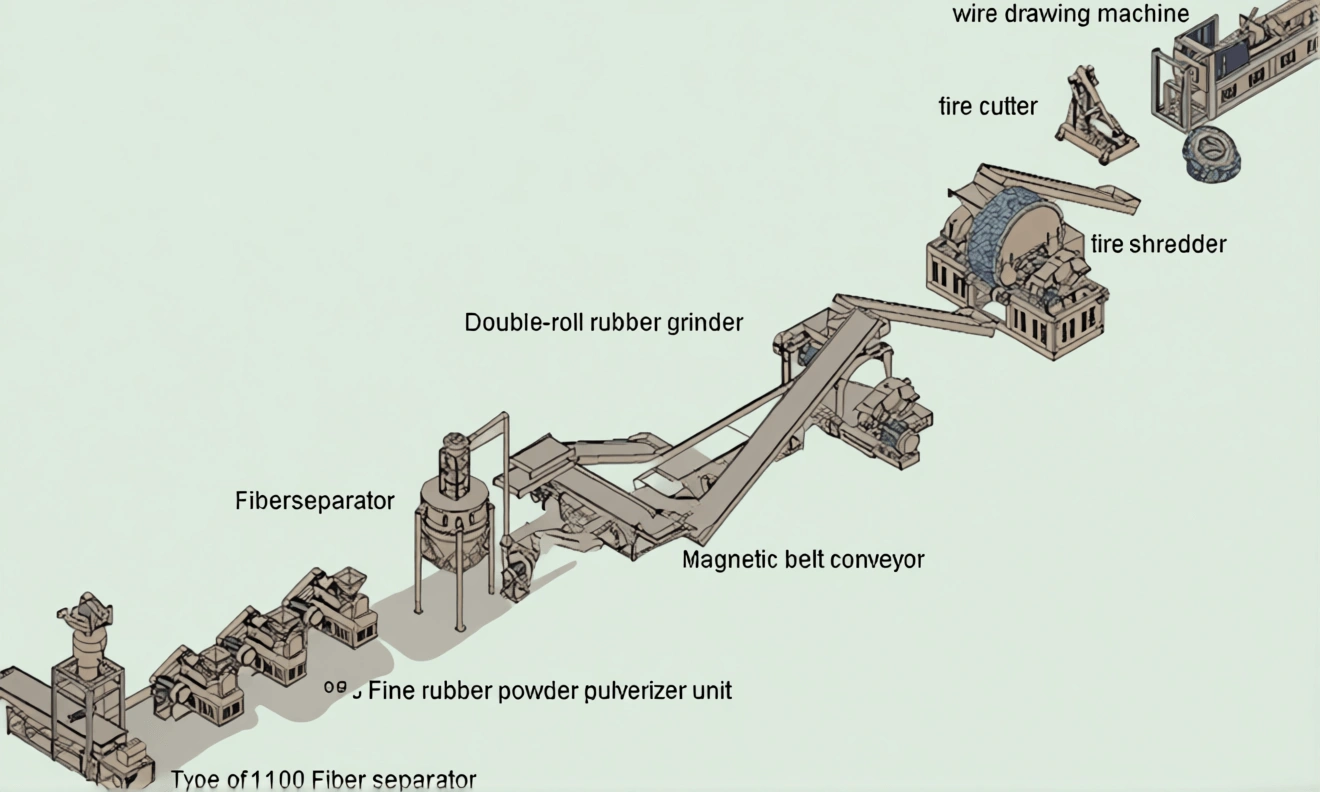
When I sit down with a new prospect, they often start by asking about "the process." What they’re really asking is: "What equipment do I need, and will it make money?" That’s a legitimate question. But I can’t answer it until I understand what they’re trying to produce. The confusion happens because tire recycling isn’t one process. It’s a family of processes, each designed to serve different markets and meet different purity standards.
Let me show you how this works in practice.
Is It Better to Recycle Tires or Burn Them for Energy?
Most people assume recycling and burning are competitors. In your plant, they’re not. They’re different answers to different business problems.
Burning tires for energy (tire-derived fuel, or TDF) extracts the calorific value locked in the rubber.2 Recycling separates rubber, steel, and fiber so each can be reused in industrial applications. Burning suits energy recovery goals. Recycling suits feedstock supply goals. The choice depends on your market access and regulatory environment, not on which is "better."

Here’s where this decision gets practical. If you have access to a cement kiln, a power plant, or a manufacturer willing to buy TDF at a stable price, energy recovery is a fast path to revenue. You shred the tire, remove the steel wire so it doesn’t damage equipment downstream, and sell the fuel. Low complexity. Mature market. But TDF prices follow energy commodity trends. When crude oil drops, so does TDF value.
Recycling takes more work upfront. You run the tire through a primary shredder. You separate steel using magnets. You remove textile fiber using air classification. Then you grind the rubber to a specific particle size. More steps. More equipment. But you end up with three saleable products instead of one. And each has its own market.
Here’s the constraint that separates these paths: What market access do you have? If a cement plant is two miles away and buying TDF regularly, burning makes sense. If you’re near cities with construction activity and rubber product manufacturers looking for feedstock, recycling makes sense. If you don’t have either, recycling is still better because the rubber powder stays valuable longer than TDF does. You can store it. You can sell it to multiple buyers.
From a regulatory angle, both paths are legal in most countries we work with. But local rules vary. Some regions classify TDF as waste material and regulate it as hazardous.3 Others have subsidies for recycled material streams. Others tax energy recovery. I always tell customers: verify your local compliance rules first. They often determine which path is actually open to you.
The financial comparison comes down to this: Burning offers faster cash flow but lower margins. Recycling offers slower initial revenue but three separate income streams. Over a five-year horizon, recycling typically produces higher cumulative return if you can secure buyer contracts for the rubber powder. But you need working capital to reach that point.
Most of the clients I work with who choose energy recovery do so because they need cash flow in months, not years. Clients who can wait 18 months to reach full capacity usually choose recycling because they want to build a stable, diversified revenue model.
Neither choice is permanent. Some of our customers start with TDF production, then add recycling equipment once they have stable cash flow and buyer relationships. The equipment is compatible. You can run both processes side by side.
Is There Any Money in Recycling Tires?
The honest answer is yes, but only if you understand what you’re actually selling and who will buy it.
Recycled tire rubber has real market value. Fine rubber powder sells for $200–$400 per ton depending on particle size, purity, and regional demand.4 Steel and fiber from tires also have commodity value. But profitability depends on your processing cost, your equipment efficiency, and whether you’ve locked in buyer contracts before you invest in the plant.

Let me break down where the money actually comes from.
What Are You Actually Selling?
When you recycle a tire, you produce three separate materials. Each has its own market and its own pricing dynamics.
Steel wire: About 15% of a typical passenger car tire is steel wire. You remove it magnetically during early processing stages. Steel is a commodity. Your local scrap buyer sets the price—typically $100–$200 per ton.5 Market is stable and liquid. You can sell it immediately. This is your fastest cash flow, but it’s the smallest revenue stream.
Textile fiber: About 5–10% of a tire is fabric reinforcement. Removing it requires air classification—basically, shaking the material and letting air blow out the lighter fibers. If you capture these fibers cleanly, some buyers want them for insulation, erosion control, or low-grade nonwoven products. Fiber value is volatile. Sometimes it’s worth collecting. Sometimes it’s worth less than your collection cost. I tell customers to treat fiber as upside, not baseline revenue.
Rubber powder: This is your main product. It’s typically 75–80% of tire mass by weight. The value depends entirely on particle size and contamination level. I’ll explain this in detail below because this is where most customers make mistakes.
The Rubber Powder Markets Drive Your Technology Choice
Fine rubber powder is the reason recycling makes money. But "rubber powder" isn’t one product. It’s a category with several distinct grades, each serving different industries.
Coarse rubber (2–5 mm): Used in landscaping, playgrounds, artificial turf underlay. Lower purity requirements. Price: $150–$250 per ton. Market is price-sensitive and grows slowly. Useful for capacity utilization but not a growth story.
Medium rubber (0.5–2 mm): The largest market segment. Used in modified asphalt for road construction, in rubber flooring, and in sports track systems. Price: $250–$400 per ton. Major construction activity in your region determines demand. This is where most customers build their primary revenue model.
Fine rubber (< 0.5 mm): Premium product. Used in molded rubber goods, shoe soles, and high-performance athletic surfaces. Price: $400–$800 per ton. Requires very clean processing because contamination is visible in the final product. Smaller market volume but higher per-ton profit if you can achieve the purity levels.
Here’s the critical insight: Your equipment choice and grinding strategy are determined by which rubber market you’re targeting, not the other way around. If you want to serve the asphalt modifier market, you need medium-fineness rubber and you need steel contamination below 200 ppm (parts per million). If you want to serve the shoe sole market, you need fine rubber and contamination below 50 ppm. These are different specifications. They require different equipment configurations.
A customer called me last year asking which equipment would "maximize output." I asked what particle size they needed. They didn’t know. I asked who their buyer was. They didn’t have one. So I told them: you’re asking the wrong question. Go find your buyer first. Get their specifications in writing. Then we’ll design the equipment to hit those specs at the lowest operating cost.
They did that. Turned out a regional asphalt contractor wanted 500 tons per month of 1–2 mm rubber powder. That specification immediately determined: primary shredder type, grinding mill specification, and separating equipment. When they aligned equipment to buyer requirements instead of general "maximum output," their operating cost went down because they weren’t overprocessing material.
How Much Can You Actually Earn?
Let me walk through a realistic scenario so you understand the math.
Assume you’re processing passenger car tires using a mechanical grinding system at normal temperature (the most common approach). Your processing cost is $35–$50 per tire depending on energy prices, labor costs, and equipment depreciation. A typical car tire weighs about 10 kg.
From one 10 kg tire, you typically extract:
- 1.5 kg steel wire (worth $0.15–$0.30)
- 0.5 kg textile fiber (worth $0.02–$0.08, often zero market value)
- 7.5 kg rubber powder (worth $1.87–$3.00 depending on grade)
Total material value: roughly $2.04–$3.38 per tire.
Minus processing cost of $35–$50 per tire… wait. That doesn’t work.
This is where customers get confused. Processing cost per tire is meaningless. You process hundreds or thousands of tires per day. Your real unit of account is tons per hour.
Let me reframe it:
A medium-size mechanical recycling system processes about 2–3 tons of tires per hour at full efficiency.6 Operating cost is about $25–$35 per ton (energy, labor, maintenance, depreciation).7 From 1 ton of tires, you extract roughly:
- 150 kg steel (worth $15–$30)
- 50 kg fiber (worth $0–$5)
- 800 kg rubber powder (worth $200–$320 depending on grade)
Total material value: $215–$355 per ton.
Minus operating cost: $190–$320 per ton gross margin.
That’s before you account for collection logistics, selling and handling costs, and equipment financing. But you can see there’s real money here if you operate at reasonable efficiency.
The clients I work with who succeed at tire recycling share three patterns: First, they secure buyer contracts before they buy equipment. No contracts means you’re speculating on commodity prices. Second, they operate at 70% or higher equipment utilization. A $2 million plant sitting idle is a wealth destroyer. Third, they focus on one rubber grade until they’re confident in their market, then they add capability.
Why Equipment Choice Matters for Profitability
This is where my role becomes relevant to your decision.
Different processing technologies have different operating costs and different output quality profiles. Mechanical grinding at normal temperature is the most common because it’s capital-efficient and works well for medium-fineness rubber that feeds the asphalt and flooring markets. Cryogenic grinding produces very clean, fine rubber but requires expensive liquid nitrogen and works best for high-volume operations. Pyrolysis recovers all material plus produces fuel oil and syngas, but requires the highest capital investment and the most sophisticated permitting.8
The technology you choose locks in your operating cost structure and your possible output markets. You can’t produce fine rubber powder efficiently with a system designed for coarse rubber. You can’t hit low contamination levels with basic mechanical separation.
Most of our customers—tire shredding plants, environmental firms, rubber product manufacturers—choose mechanical grinding because the capital cost is reasonable, the technology is proven, and the output quality aligns with major markets (asphalt, flooring, sports tracks). But before they commit to equipment, we work through their specific constraints: particle size requirement, contamination tolerance, annual tonnage target, and buyer specifications.
That’s the decision framework. You don’t choose equipment based on what sounds good. You choose it based on what your buyer demands and what your budget allows.
Conclusion
Tire recycling profitability depends on three aligned decisions: technology selection, output specification, and buyer commitment. Choose based on your market access, not on generic "best practices."
-
"Tire recycling – Wikipedia", https://en.wikipedia.org/wiki/Tire_recycling. According to educational resources on waste management, tire recycling methods such as mechanical grinding, pyrolysis, and cryogenic processing are distinct approaches tailored to specific output requirements and economic constraints. Evidence role: definition; source type: education. Supports: Confirms the existence of multiple tire recycling methods and explains their differences.. ↩
-
"Tire-Derived Fuel | Scrap Tires | US EPA", https://archive.epa.gov/epawaste/conserve/materials/tires/web/html/tdf.html. Research studies on tire-derived fuel confirm that tires have a high calorific value, making them suitable for energy recovery in industrial applications such as cement kilns and power plants. Evidence role: mechanism; source type: research. Supports: Explains how burning tires recovers energy through their calorific value.. Scope note: Environmental impacts of burning tires may vary depending on local regulations and emissions control technologies. ↩
-
"Hazardous Waste – Illinois Environmental Protection Agency", https://epa.illinois.gov/topics/waste-management/waste-disposal/hazardous-waste.html. Government environmental regulations in certain regions classify tire-derived fuel (TDF) as hazardous waste, requiring compliance with specific handling and disposal standards. Evidence role: case_reference; source type: government. Supports: Provides examples of regions where TDF is classified as hazardous waste and regulated accordingly.. Scope note: Regulations vary widely by country and local jurisdiction. ↩
-
"Micronized Rubber Powder Market Research Report 2034 – Dataintelo", https://dataintelo.com/report/global-micronized-rubber-powder-market. Market analysis from industry institutions indicates that fine rubber powder derived from recycled tires typically sells for $200–$400 per ton, with pricing influenced by particle size, purity, and regional demand. Evidence role: statistic; source type: institution. Supports: Provides market data on the pricing and demand for recycled tire rubber powder.. Scope note: Prices may fluctuate based on local economic conditions and buyer specifications. ↩
-
"Iron and Steel Scrap Statistics and Information – USGS.gov", https://www.usgs.gov/centers/national-minerals-information-center/iron-and-steel-scrap-statistics-and-information. Government reports on scrap metal markets indicate that steel scrap prices generally range from $100–$200 per ton, depending on regional demand and quality. Evidence role: statistic; source type: government. Supports: Confirms the typical price range for steel scrap as a commodity.. Scope note: Prices may vary significantly based on local market conditions and global steel demand. ↩
-
"Industrial Turnkey Tire Recycling Systems", https://www.granutech.com/recycling-systems.html. Educational materials on tire recycling equipment indicate that medium-size mechanical systems typically process 2–3 tons of tires per hour under optimal conditions. Evidence role: statistic; source type: education. Supports: Provides data on the processing capacity of medium-size mechanical recycling systems.. Scope note: Actual capacity may vary based on equipment configuration and operating conditions. ↩
-
"Waste tire management and recycling fee", https://www.tax.ny.gov/bus/tire/wtm.htm. Industry reports on tire recycling operations indicate that operating costs generally range from $25–$35 per ton, factoring in energy, labor, maintenance, and depreciation. Evidence role: statistic; source type: institution. Supports: Confirms the typical operating cost range for tire recycling plants.. Scope note: Costs may vary based on regional energy prices and labor rates. ↩
-
"Tire recycling – Wikipedia", https://en.wikipedia.org/wiki/Tire_recycling. Research on pyrolysis technology confirms that it recovers all tire materials and produces fuel oil and syngas, but requires significant capital investment and compliance with stringent permitting regulations. Evidence role: mechanism; source type: research. Supports: Explains the pyrolysis process for tire recycling and its outputs, including fuel oil and syngas.. Scope note: Economic feasibility depends on local energy markets and regulatory frameworks. ↩

